Sunday, April 26, 2015

Medicine+Technology+Art

This week Dr.Vesna talked about how important art is relative to the development of medicine and technological advancement. Whether it is in the past or in the present, anatomy and dissection has been greatly looked at as a collaboration of art and science. Artists who focus their work on the human body are great assets to researchers because their art illustrations can help researchers gain a better understanding how the human body works and document important facts in the process (Dr. Vesna, 2012). The art of the human body is also central for understanding how our identities are shaped in our society which includes gender, sexuality, race, and ethnicity (MoMa, n.d.). During the 1960s and 1970s, most of the work produced by human body artists focused on depicting how western art perpetuated idealizations of the female form. These idealizations still affect us today in the way we think about how we look and how we should act in order to fit with social conventions. Art itself is a reflection of humanity (Ruggles, 2011).
Self portrait by John Coplans 


The Human Body in Art by Joanne Beaule Ruggles

We have been dissecting human bodies since the beginning of human history because dissection is an effective way of understanding the human body. The study of human anatomy has contributed to the development of modern medicine. Anatomical illustrations helped improve the medical community. Andreas Vesalius for example, is one of the most influential figures in the scientific world because of his passion for studying the human body.The anatomical images in his book De Humani Corpis Fabrica was the earliest presentation of human anatomy (Famous Scientists, n.d.). His work showed the complexity of the human body formation and influenced many other scholars and artist to take interest in the study of the human body which lead to further development in this field of study (British Library, n.d.). 
Muscle Man by Andreas Vesalius


1) "Investigating Identity." Moma. Web. <http://www.moma.org/learn/moma_learning/themes/investigating-identity/the-body-in-art>.

2) MoMa Learning. John Coplans. Self Portrait. Digital Image .

3) Vesna, Victoria. "Medicine Pt 1: Human Body and Medical Technologies." UCOnline, 21 Apr. 2012. Web. 26 Apr. 2015. <https://youtu.be/Ep0M2bOM9Tk>.

4) Ruggles, Joanne Beaule. "Joanne Beaule Ruggles Captures the Human Body in Art."Figurative Artist. 25 Feb. 2011. Web. 26 Apr. 2015. <http://www.figurativeartist.org/joanne-beaule-ruggles-captures-the-human-body-in-art/>.
5) Figurative Artist. Joann Beaule Ruggles. The Human Body in Art. Digital Image.

6) "Vesalius's Renaissance Anatomy Lessons." Learning Bodies of Knowledge. British Library. Web. 26 Apr. 2015. <http://www.bl.uk/learning/artimages/bodies/vesalius/renaissance.html>.

7) Library British. Andreas Vesalius. Muscle Man. Digital Image.

8) "Andreas Vesalius: Contributions and Achievements:." Famous Scientists: The Art If Genius. Web. 26 Apr. 2015. <http://www.famousscientists.org/andreas-vesalius/>.


Sunday, April 19, 2015

Robotics + Art

This week, Dr. Vesna discusses how Gutenberg's invention of the printing press was proven to make mass production possible which also inspired other scientists to develop ideas about art and robotics. However, creations of robotics using art have not always been beneficial to our society. Take Ford for example. Ford was the first to use the idea of mass production and create the assembly line (Uconline Program, 2012). His used his idea of the assembly line to create cars and had different labors working on different parts (U-S-History, n.d.).

 Back in the early 1940s, it was hard to own a car and only the wealthy were able to afford for such a luxury item. The assembly line lead to the problem of taylorism where workers began to look like they were apart of the products they were producing (Bedoire, n.d.). In a way, Ford's use of the assembly line is an example of Marxism where Marx specifically studied the class relations and societal conflicts between the two class: capitalist and proletariat (Nisbet, 2013). The cars Ford were producing were made so that only the capitalists would be able to afford them. Marx understood that idea and also focused on studying how as a result of capitalism and laborers being stripped away from their mode of production, laborers become alienated and dehumanized (Ollman, 2015). Frederick Winslow Taylor's idea of taylorism is very similar to Marx's idea of alienation because in both perspectives, laborers are not aware that they are being objectified.
Sweden, 1940s, Telefonplan Plant


"Henry Ford." United States History. Web. <http://www.u-s-history.com/pages/h1621.html>.

United States History. Early Ford Assembly Line. Digital Image.

Ollman, Bertell. "What Is Marxism? A Bird's-Eye View." Dialectical Marxism. Bertell Ollman. Web. <http://www.nyu.edu/projects/ollman/docs/what_is_marxism.php>.

Robert A., Nisbet. "Social Science." Encyclopaedia Britannica. 2013. Print.<http://www.britannica.com/EBchecked/topic/551385/social-science/38930/Marxist-influences>

Chaweye, Soraya. Fordism Calling. Digital Image.

Bedorie, Fredric. Sweden 1940s, Telefonplan Plant. Digital Image.

Bedoire, Fredric. "MIDSOMMARKRANSEN! TAYLORISM AS ARCHITECTURE." The History of Ericsson. Web. <http://www.ericssonhistory.com/places/stockholm/Midsommarkransen--Taylorism-as-architecture/>.

Vensa, Victoria. Robotics + Art LectureUCOnline. N.p., n.d. Web. 19 Apr. 2015. <https://www.youtube.com/watch?v=oAZ8bo9T_Pk>, <https://www.youtube.com/watch?v=wkP7oSZVkbg>.

Sunday, April 12, 2015

Week 2

Composition in Brown and Grey by Piet Mondrian 1913

Even thought math and art may seem very different and people often times do not see how they interrelate, people who like math will most likely look for mathematics in art. Math is needed everywhere and in almost all art work as it is needed for basic measuring of lines and different angles. This week, Dr. Vesna talked about math and art and how artist use mathematics to create art work. In her lecture, one of the artists who use mathematics to create art is Mondrian, a dutch artist in the 1930s who was famous for using horizontal lines in many of his drawings and paintings. Due to his strong believes in mathematics, he used lines and shapes to outline his creations and use primary colors to express reality and nature.  Mondrian believed that paintings using lines and colors should serve as an example to other arts in defining “beauty”. 

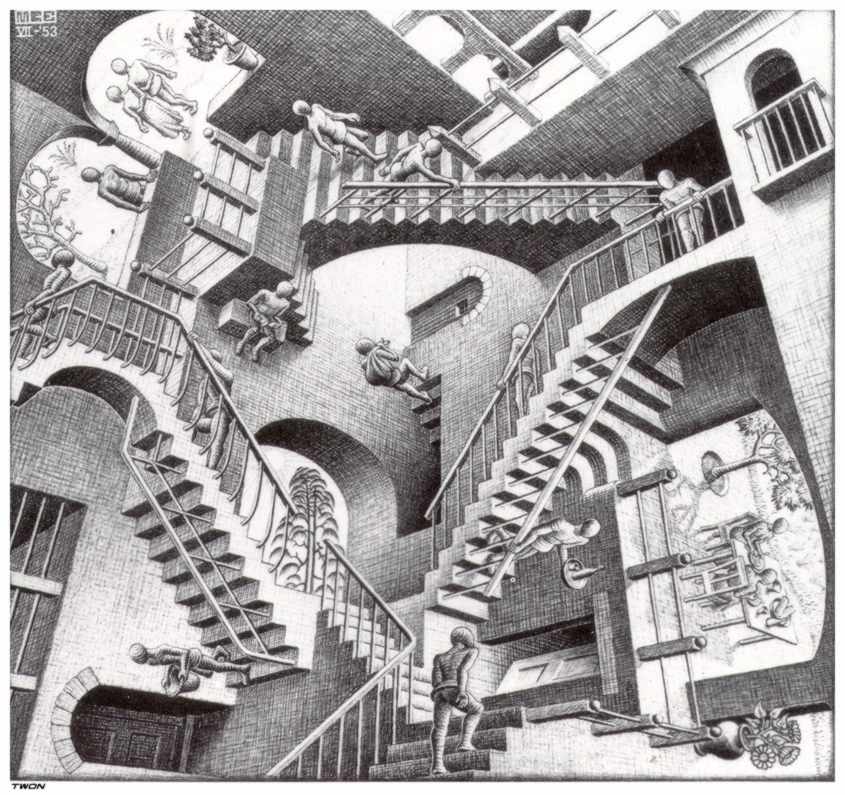
I find M.C Escher's work especially fascinating because he is so talented in creating art pieces that are unique and different from other artists. M.C. Escher was famous for creating art work that is mathematically impossible but to the human eye look very realistic just like this piece below. In this drawing, the staircases are ascending and descending which looks very much real but mathematically impossible. 
Relativity by M.C. Escher
Circle Limit III by M.C. Escher

M.C Escher also believed that with simple shapes such as squares, triangles, and hexagons are sufficient enough to create art which inspired him some of his art pieces in Alhambra Sketch.

Sources and Links:

1) https://youtu.be/mMmq5B1LKDg
2)http://mathcentral.uregina.ca/beyond/articles/Art/art1.html
3)http://www.moma.org/collection/browse_results.php?criteria=O%3AAD%3AE%3A4057&page_number=4&template_id=1&sort_order=1
4) http://www.nga.gov/collection/gallery/ggescher/ggescher-main1.html
5)http://www.theartstory.org/artist-mondrian-piet.htm

Works Cited:

Vesna, Victoria. “Mathematics-pt1-ZeroPerspectiveGoldenMean.mov.” Cole UC online. Youtube, 9 April 2012. Web. 11 Oct. 2012. <http://www.youtube.com/watch?v=mMmq5B1LKDg&feature=player_embedded>
Escher, M.C. Relativity. 1953. Photograph. Math CentralWeb.<http://mathcentral.uregina.ca/beyond/articles/Art/relativity.jpg>

Escher, M.C. Circle Limit III. 1959. Photograph. M.C. Escher Web. <http://mcescher.com/wp-content/uploads/2013/10/LW434-MC-Escher-Circle-Limit-III-1959.jpg>

Mondrian, Piet. Composition in Brown and Grey. 1913. Photograph. The Museum of Modern Art: The Collection. Web <http://www.moma.org/collection_images/resized/155/w500h420/CRI_151155.jpg>


J. Bendien. Nieuwe richtingen in de schilderkunst: Het neo-plasticisme [New directions in painting: Neo-Plasticism] (Amsterdam, 1935), pp. 21–45. Oxford University Press. 


Sunday, April 5, 2015

Week 1 Blog:

In Toward a Third Culture: Being in Between, Professor Vesna talks about how there is divide between the literary humanities and sciences creating the "two cultures". Professor Vesna remind readers of C.P. Snow's argument that the curricula of schools and universities are the reasons for the separation between the humanities and sciences. Both Professor Vesna and Snow argue that it is impossible to keep the arts separate from the sciences because work from both professions are interrelated. According to Professor Vesna, technologies and scientific discoveries are what inspires artists to create and explore new innovations. However, schools and universities reinforce this inequality by dividing the literary humanities and sciences into two cultures. An example of the two cultures is demonstrated on UCLA campus with the sciences in South campus and the art humanities in North campus. Before reviewing this week's readings, I never thought about the importance of science in relation to art. I never took the time to think about how art using computer technologies is a form of art. Understanding Snow's perspective changed my thinking about students from North and South campus. South campus majors have knowledge about sciences that can be beneficial to North campus majors studying arts and vice versa. I believe that understanding the importance of science in relation to the humanities is essential in everyday life, not just in creating art. People depend on one another for information and knowledge. Understanding information beyond our field of study can make us more knowledgeable and have a better understanding of the world.

                                            Dynamic Performance of Nature by EB Office:
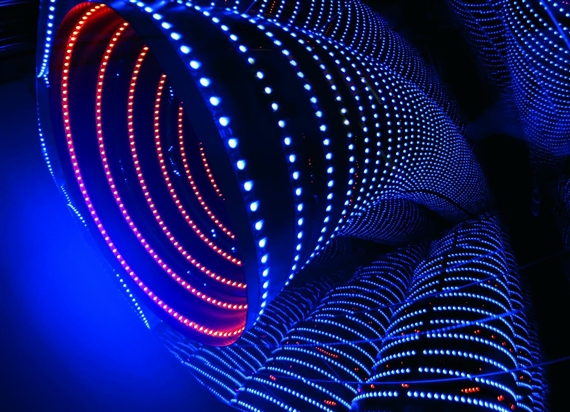
Art Fair of the Future: Tunnel View
How Art, Science, and Technology Interact in Southern California


Snow, C.P. The Two Cultures and The Scientific Revolution. Cambridge University Press. New York. 1961.
Vesna, Victoria. Toward a Third Culture: Being in Between in Leonardo, Vol. 34, No. 2.The MIT Press. 2001
"Dynamic Peformance of Nature by EB Office". Archinect. Connecting Architects Since 1997. Walter, Alexander. 21 Nov. 2011. 
"Art Fair of the Future: Tunnel View". Mutual Art. Kotter, Han. 1 Feb. 2012.
"How Art, Science, and Technology Interact in Southern California" KCET. Nowlin, Stephen. 20 March. 2015.


Thursday, April 2, 2015

Hello All,

My name is Tsz Wong but I prefer to be called Lulu. I am currently a 4th year student majoring in Sociology with a minor in Education. I enjoy little adventures and playing sports. For spring break, my boyfriend and I went para-sailing in Newport Beach! The weather was nice and we had a great time! I signed up for this course because I thought it would be interesting to learn more about how scientific innovations inspire the art culture.


Here is a picture of us 800 ft up in the air (it was actually pretty scary).