
Composition in Brown and Grey by Piet Mondrian 1913
Even thought math and art may seem very different
and people often times do not see how they interrelate, people who like math
will most likely look for mathematics in art. Math is needed everywhere and in
almost all art work as it is needed for basic measuring of lines and different
angles. This week, Dr. Vesna talked about math and art and how artist use
mathematics to create art work. In her lecture, one of the artists who use
mathematics to create art is Mondrian, a dutch artist in the 1930s who was
famous for using horizontal lines in many of his drawings and paintings. Due to
his strong believes in mathematics, he used lines and shapes to outline his
creations and use primary colors to express reality and nature. Mondrian believed that paintings using lines
and colors should serve as an example to other arts in defining “beauty”.
I find M.C Escher's work especially fascinating because he is so talented in creating art pieces that are unique and different from other artists. M.C. Escher was famous for creating art work that is mathematically impossible but to the human eye look very realistic just like this piece below. In this drawing, the staircases are ascending and descending which looks very much real but mathematically impossible.
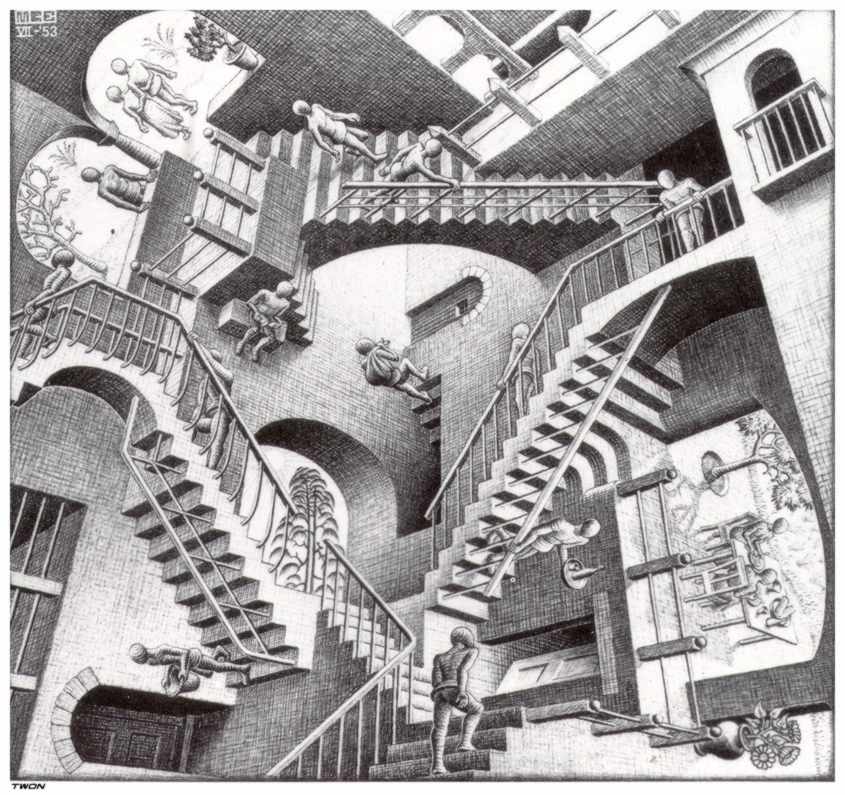
Relativity by M.C. Escher

Circle Limit III by M.C. Escher
M.C Escher also believed that with simple shapes such as squares, triangles, and hexagons are sufficient enough to create art which inspired him some of his art pieces in Alhambra Sketch.
Sources and Links:
1) https://youtu.be/mMmq5B1LKDg
2)http://mathcentral.uregina.ca/beyond/articles/Art/art1.html
3)http://www.moma.org/collection/browse_results.php?criteria=O%3AAD%3AE%3A4057&page_number=4&template_id=1&sort_order=1
4) http://www.nga.gov/collection/gallery/ggescher/ggescher-main1.html
5)http://www.theartstory.org/artist-mondrian-piet.htm
Works Cited:
Vesna, Victoria. “Mathematics-pt1-ZeroPerspectiveGoldenMean.mov.” Cole UC online. Youtube, 9 April 2012. Web. 11 Oct. 2012. <http://www.youtube.com/watch?v=mMmq5B1LKDg&feature=player_embedded>
Escher, M.C. Relativity. 1953. Photograph. Math CentralWeb.<http://mathcentral.uregina.ca/beyond/articles/Art/relativity.jpg>
Escher, M.C. Circle Limit III. 1959. Photograph. M.C. Escher Web. <http://mcescher.com/wp-content/uploads/2013/10/LW434-MC-Escher-Circle-Limit-III-1959.jpg>
Mondrian, Piet. Composition in Brown and Grey. 1913. Photograph. The Museum of Modern Art: The Collection. Web <http://www.moma.org/collection_images/resized/155/w500h420/CRI_151155.jpg>
J. Bendien. Nieuwe richtingen in de schilderkunst: Het neo-plasticisme [New directions in painting: Neo-Plasticism] (Amsterdam, 1935), pp. 21–45. Oxford University Press.

Hi Lulu!
ReplyDeleteI share your sentiments towards M.C. Esher's works! His work was always so fascinatingly intricate to me.
"Relativity" is actually one of my favorite works of his, because, like you said, the ambiguity and mathematically impossibility of the piece along with its realistic impressions really intrigues me. Are there any other artists or pieces that you fascinates you as Esher does?
I also find it fascinating that you brought up MC Esher. Because the optical illusions he creates have a lot of artistic merits, as well as scientific ones. Now thinking about it, I hear his name more often in science classes than art classes. MC Esher really embodies the art + math as a modern artist.
ReplyDeleteI agree with your statement, "Math is needed everywhere and in almost all art work as it is needed for basic measuring of lines and different angles." And I think Mondrian's art is about proving that statement correct. He reduced art (painting) to lines, geometry, and colors, seeking a certain universality, demonstrating that math underlies all paintings.