Sunday, May 31, 2015

Week 9 - Space + Art:

This week, Professor Vesna introduced the idea of space and art and explained in her lecture video that "we have all been fascinated by the sky, the stars, and the planets" since the beginning of time. The unknown galaxy has continued to bring excitement to artists' lives and inspire them to create artistic pieces all around the world. One artist in particular, is recognizable for being highly specialized in the field of technological space art, Vincent Di Fate (Biography, 2004). Vincent is famous for his paintings of distant environments such as space and etc. His paintings of space are currently displayed in the Kennedy Space Center at Cape Canaveral.

The influence of space and art also inspired many artist to grow great interest in rockets and the stars before the 1960's. It was also during the time of the cold war that the influence of space and art were demonstrated in the space propaganda where both the USSR and the United States were in a race to space. Both USSR and the United States produced art pieces to show that their country was in the lead for developing advance space technology (Fenlon, 2012). 

If we look back in history, space films and science fiction novels on space have always been fictional. Before 1969, living and working in space seemed impossible and people can only imagine how the unknown galaxy looks like in space (NASA, 2014). Today, living and working in space is possible all thanks to artists, scientists, and engineers studying space technology. Artists continues to be inspired by the concept of space which brings us closer to understanding the solar system on a deeper level. 
The space station from 2001

Vesna, Victoria. "8 Space Intro 1280x720." YouTube. YouTube, 29 July 2013. Web. 23 May 2015. <https://www.youtube.com/watch?v=2dPAmpBiVHY>.

"Vincentdifate.com." Vincentdifate.com. Vincent DiFate, 2004. Web. 23 May 2015. <http://www.vincentdifate.com/biography.html>.

 "1968 Science Fiction Is Today's Reality." NASA. NASA Gov, 21 Oct. 2014. Web. <https://www.nasa.gov/mission_pages/station/main/2001_anniversary.html#.VWv0089Viko>  

 Nastasi, Allison. "Cosmic Art Installations Inspired by Space." Flavorwire. 5 Apr. 2014. Web.  <http://flavorwire.com/449482/cosmic-art-installations-inspired-by-space>
 
Fenlon, Wesley. "How Sci-Fi Propaganda Art Influenced The US and Soviet Space Race." Tested. 3 Apr. 2012. Web.<  http://www.tested.com/art/43726-sci_fi-art-propaganda-across-cultures/>

Images:

"1968 Science Fiction Is Today's Reality." NASA. NASA Gov, 21 Oct. 2014. Web. Image. <https://www.nasa.gov/sites/default/files/images/2001_station.jpg>

Fenlon, Wesley. "How Sci-Fi Propaganda Art Influenced The US and Soviet Space Race." Tested. 3 Apr. 2012. Web. Image. http://files.tested.com/photos/2012/04/02/55-37211-teaser1.jpg>

Fenlon, Wesley. "How Sci-Fi Propaganda Art Influenced The US and Soviet Space Race." Tested. 3 Apr. 2012. Web. Image. <http://files.tested.com/photos/2012/04/02/55-37213-bonestell-1.jpg>

Sunday, May 24, 2015

Week 8: Nanotech+Art

This week, Dr. Gimzewski talked about the origin of nanotechnology and how the development of this technology has the potential to change the world and is beneficial to the human race. Nanotechnology has the ability to build inventions at a molecular scale to make high performance products that can better peoples' lives (CRN, n.d). At the nanoscale, objects are so tiny that the naked eye cannot see them. According to Dr. Stoermer from the Institute of Materials Research, it is difficult for people to understand nanotechnology without a good background in multiple sciences related to the field. What we do know is that many scientists are currently studying and experimenting different substances at the nanoscale to find how their properties may be beneficial to the world. For example, engineers are currently trying to develop nano-size wires to make more powerful micro-processors and doctors are studying ways nanoparticles may be applicable to improve their patient's health (Bonsor and Strickland, n.d.).
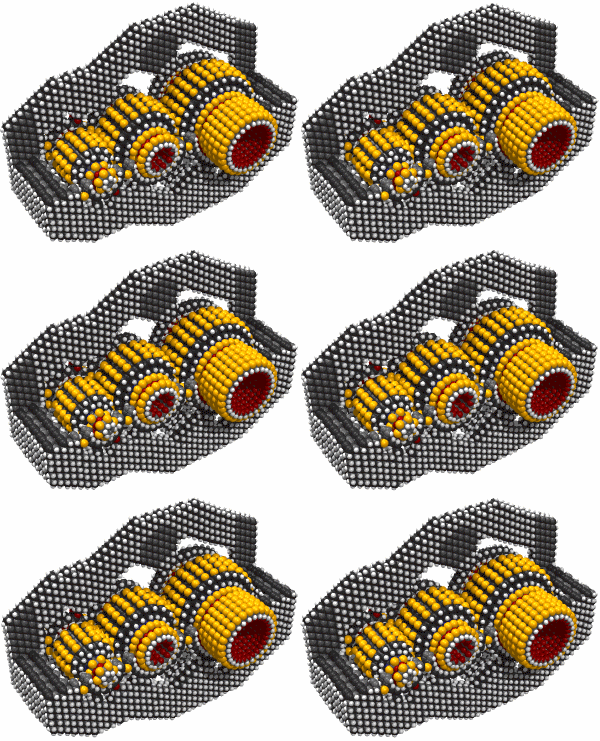
Parallel shaft speed reducer- largest nano mechanical devices ever modeled

Nanotechnology is becoming a great part of our lives. Boyle reports 7 ways in which nanotechnology is changing the world we live in. One of them is the invention of the new gold nanoparticle sensors that has the ability to detect early stages of cancer. The use of nanoparticles is not only beneficial to cancer patients but can also help doctors find ways to treat all other patients and determine infections as well (Boyle, 2012). 

For this week's blog, as I researched more about nantechnology products, I found that clay coating keeps the air in tennis balls. Clay nanoparticles keep air molecules from escaping and helps tennis balls last longer (Discover Mag, 2010). Nanotechnology is used in almost everything in our lives, they are just to small for us to notice. 


 Bonsor, Kevin, and Jonathan Strickland. "How Nanotechnology Works." How Stuff Works. Web. 24 May 2015.< http://science.howstuffworks.com/nanotechnology.htm>

 Boyle, Rebecca. "7 AMAZING WAYS NANOTECHNOLOGY IS CHANGING THE WORLD." Popular Science. 12 Nov. 2012. Web. < http://www.popsci.com/science/article/2012-11/7-amazing-ways-nanotechnology-changing-world?image=1>

 "What Is Nanotechnology?" Center for Responsible Nanotechnology. Web. 24 May 2015. <  http://www.crnano.org/whatis.htm>

 "Nanotechnology Pt 1." Youtube. 21 May 2012. Web.<https://www.youtube.com/watch?v=q7jM6-iqzzE&feature=youtu.be>
  
 "The 9 Best Nanotechnology-Powered Products." Discover Magazine. 29 June 2010. Web.  <http://discovermagazine.com/galleries/zen-photo/n/nanotech-products>

Boyle, Rebecca. "7 AMAZING WAYS NANOTECHNOLOGY IS CHANGING THE WORLD." Popular Science. 12 Nov. 2012. Web Image. < http://www.popsci.com/sites/popsci.com/files/styles/medium_1x_/public/import/2013/images/2012/11/Cancer%20detector_0.jpg?itok=P3i9Elfg>

 "What Is Nanotechnology?" Center for Responsible Nanotechnology. Web Image. 24 May 2015. < http://www.crnano.org/srg-iii-pov-animation2.gif>


 "The 9 Best Nanotechnology-Powered Products." Discover Magazine. 29 June 2010. Web Image. <http://discovermagazine.com/~/media/Images/Zen%20Photo/N/nanotech%20products/311.jpg?mw=738>


Sunday, May 17, 2015

Week 7 Neuroscience + Art

The human brain is very complex and in attempt to understand it, artists are responding differently to the field of neuroscience. The human brain enables us to process information and create thoughts in nano seconds (Vesna, 2012). There is still much to learn about the human brain. Although we have made progress, the information we know currently are still limited like understanding the reason why we use only a small percentage of our brain to think and process our thoughts. What do we do with the rest of our brain? We have yet to find the reason behind the way our minds are able to control our body to perform certain tasks. Professor Vesna touched on the idea of consciousness this week and what is interesting to me is how we communicate using our mind and how we are able to comprehend the information given to us. Consciousness allows us to associate events and objects with what we know and what we are aware of (The Brain Bank, 2013). Consciousness is like a information processing system that enables all animals and humans to be conscious and aware of our surroundings (Keim, 2013).
Consciousness - Shutterstock


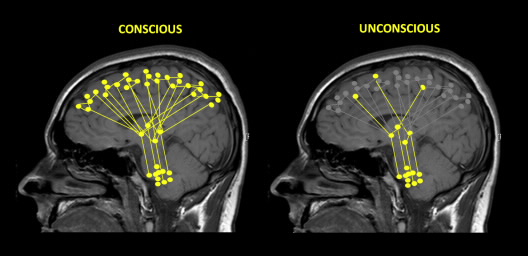
Many scientists and artists have attempt to study the human brain to understand its unique functions but still do not have a full explanation for how it really works. Theories of the brain began with the belief that the human heart controlled the human mind to understanding the mind using the measurement of the skull. The invention of electricity has helped scientists and artists research where the brain begins (Vesna, 2012). To begin, many scientists and artists until today have been trying to understand consciousness. Research has shown that when electricity stimulated a part of the brain called the clasutrum, a person becomes instantly unconscious (Lewis, 2014). Still, such findings fail to explain why other parts of the brain do not control consciousness and whether or not consciousness is present in brain damaged patients. In another research conducted by University of Cambridge, researchers found that some patients in vegetable state who lack the ability to integrate information efficiently are showing signs of consciousness which supports the idea of having awareness (Akst, 2014). However much research is needed in the neuroscience field in understanding how brain damaged patients may be assisted through the understanding of consciousness.


Conscious VS. Unconscious 
Illustrated brain networks in two vegetative patients (left and middle), but one of whom imagined playing tennis (middle), alongside a healthy adult (right). -Srivas Chennu


 "What Is Consciousness? A Scientist’s Perspective." The Brain Bank. 4 Mar. 2013. Web.  <http://thebrainbank.scienceblog.com/2013/03/04/what-is-consciousness-a-scientists-perspective/>

 Lewis, Tanya. "Scientists Closing in on Theory of Consciousness." Live Science. Purch, 30 July 2014. Web.<http://www.livescience.com/47096-theories-seek-to-explain-consciousness.html>.  

 Vesna, Victoria. "Neuroscience-pt1." Youtube. UCOnline, 17 May 2012. Web. <https://www.youtube.com/watch?v=TzXjNbKDkYI&feature=youtu.be> .  

 Keim, Brandon. "A Neuroscientist’s Radical Theory of How Networks Become Conscious." Wired. 13 Nov. 2013. Web. <  http://www.wired.com/2013/11/christof-koch-panpsychism-consciousness/>.

 Akst, Jef. "Still There." The Scientist. 20 Oct. 2014. Web.  <http://www.the-scientist.com/?articles.view/articleNo/41253/title/Still-There/>

 Lewis, Tanya. "Will We Ever Understand Consciousness? Scientists & Philosophers Debate." Live Science. Purch, 31 May 2013. Web. Image <http://i.livescience.com/images/i/000/053/366/i02/consciousness.jpg?1370032937> .

 "What Is Consciousness? A Scientist’s Perspective." The Brain Bank. 4 Mar. 2013. Web. Image  <http://thebrainbank.scienceblog.com/files/2013/03/ev.owa_2.jpeg>.

 Akst, Jef. "Still There." The Scientist. 20 Oct. 2014. Web. Image  <http://www.the-scientist.com/images/Nutshell/October2014/brain%20scans.jpg>


Sunday, May 10, 2015

Week 6

This week, Professor Vesna talks about biotech and art and the controversy on how animals are used for testing in bioart projects. When talking about bioarts and technology, it is worth mentioning Eduardo Kac, the creator of the GFP bunny, Alba. He used a gene called the glowing green fluorescent protein (GFP) found in the Aequorea Victoria jellyfish and modified it to make it more powerful and injected into rabbit egg cells which ultimately spread throughout the bunny's body creating a glowing body. Alba is known as a transgenic animal that carries a foreign gene from another animal that has been inserted by humans to have similar features of the other animal (Transgenic Animals, 2011). By using biotechnology, scientists are able to study genetics on a different level. Many scientist have been known to use animals to study biological processes and diseases. The GFP gene is able to tag certain genes of protein in the human body allowing scientists to watch the effective of drugs and illnesses without actual surgery. Some benefits that come from transgenic animal studies include developing disease resistance and other medical applications. Scientists are in the process of producing disease resistant animals such as influenza resistant pigs which is a study that will benefit many humans from dying of disease illnesses (Margawati, 2003).

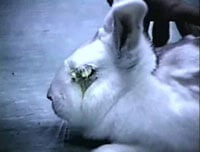
However there has been a strong controversy on whether it is right to test on animals. According to the People for the Ethical Treatment of Animals, more than 241,000 rabbits are abused in U.S. laboratories every year. Many animals have suffered greatly to support successful artists and scientists in genetic testing and development. Those in favor of animal testing however would argue that experiments on animals are necessary to advance medical and biological knowledge (Hajar, 2011). Even though there is a strong debate between those who study bioart and those who are anti animal testing, biotechnology and studies in genetics have no doubt provided humans with technological and medical advancement and will most likely continue to do so in the future. 
PETA, Rabbit in testing
Human Ear on Mouse
Animal Testing, Ghannan 2013

 "Rabbits in Laboratories." People for the Ethical Treatment of Animals. Web. 7 May 2015. <http://www.peta.org/issues/animals-used-for-experimentation/rabbits-laboratories/>

 Hajar, Rachel. "Animal Testing and Medicine." U.S. National Library of Medicine. Medknow Publications, 2011. Web.<http://www.ncbi.nlm.nih.gov/pmc/articles/PMC3123518/>

 Hajar, Rachel. "Animal Testing and Medicine." U.S. National Library of Medicine. Medknow Publications, 2011. Web. <http://www.ncbi.nlm.nih.gov/pmc/articles/PMC3709868/>

 Margawati, Endang Tri. "Transgenic Animals: Their Benefits To Human Welfare." Actionbioscience. American Institute of Biological Sciences, 2003. Web <http://www.actionbioscience.org/biotechnology/margawati.html#primer>  

 Vesna, Victoria. "Biotechnology and Art." Youtube. 18 Sept. 2013. Web. <https://www.youtube.com/watch?v=PaThVnA1kyg&feature=youtu.be>  

 "Rabbits in Laboratories." People for the Ethical Treatment of Animals. Image. Web. 7 May 2015. <http://www.peta.org/wpcontent/uploads/2013/10/200_2D00_IssuesExperimentCrueltyRabbits.jpg>  

 Buy, Marie. "Transgenic Animal." NewinfoUK. 1 June 1997. Web. Image <http://www.newsnfo.co.uk/images/trans%20genics%20mouse%20ear%20googlei%20search.jpg>  

 Ghannam, Talha. "Animal Testing – Right or Wrong." Centre for Islam Medicine. 23 Oct. 2013. Web. <http://www.thecim.org.uk/wp-content/uploads/2014/10/Animal-testing.jpg>