The human brain is very complex and in attempt to understand it, artists are responding differently to the field of neuroscience. The human brain enables us to process information and create thoughts in nano seconds (Vesna, 2012). There is still much to learn about the human brain. Although we have made progress, the information we know currently are still limited like understanding the reason why we use only a small percentage of our brain to think and process our thoughts. What do we do with the rest of our brain? We have yet to find the reason behind the way our minds are able to control our body to perform certain tasks. Professor Vesna touched on the idea of consciousness this week and what is interesting to me is how we communicate using our mind and how we are able to comprehend the information given to us. Consciousness allows us to associate events and objects with what we know and what we are aware of (The Brain Bank, 2013). Consciousness is like a information processing system that enables all animals and humans to be conscious and aware of our surroundings (Keim, 2013).

Consciousness - Shutterstock
Many scientists and artists have attempt to study the human brain to understand its unique functions but still do not have a full explanation for how it really works. Theories of the brain began with the belief that the human heart controlled the human mind to understanding the mind using the measurement of the skull. The invention of electricity has helped scientists and artists research where the brain begins (Vesna, 2012). To begin, many scientists and artists until today have been trying to understand consciousness. Research has shown that when electricity stimulated a part of the brain called the clasutrum, a person becomes instantly unconscious (Lewis, 2014). Still, such findings fail to explain why other parts of the brain do not control consciousness and whether or not consciousness is present in brain damaged patients. In another research conducted by University of Cambridge, researchers found that some patients in vegetable state who lack the ability to integrate information efficiently are showing signs of consciousness which supports the idea of having awareness (Akst, 2014). However much research is needed in the neuroscience field in understanding how brain damaged patients may be assisted through the understanding of consciousness.
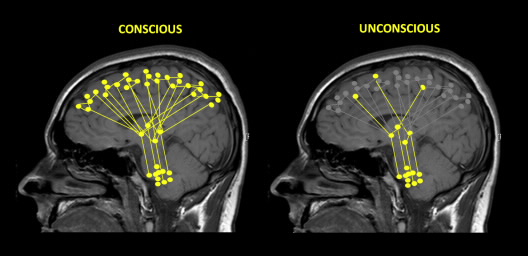
Conscious VS. Unconscious

Illustrated brain networks in two vegetative patients (left and middle), but one of whom imagined playing tennis (middle), alongside a healthy adult (right). -Srivas Chennu
"What Is Consciousness? A Scientist’s Perspective." The Brain Bank. 4 Mar. 2013. Web. <http://thebrainbank.scienceblog.com/2013/03/04/what-is-consciousness-a-scientists-perspective/>
Lewis, Tanya. "Scientists Closing in on Theory of Consciousness." Live Science. Purch, 30 July 2014. Web.<http://www.livescience.com/47096-theories-seek-to-explain-consciousness.html>.
Lewis, Tanya. "Will We Ever Understand Consciousness? Scientists & Philosophers Debate." Live Science. Purch, 31 May 2013. Web. Image <http://i.livescience.com/images/i/000/053/366/i02/consciousness.jpg?1370032937> .

No comments:
Post a Comment