This week, Professor Vesna talks about biotech and art and the controversy on how animals are used for testing in bioart projects. When talking about bioarts and technology, it is worth mentioning Eduardo Kac, the creator of the GFP bunny, Alba. He used a gene called the glowing green fluorescent protein (GFP) found in the Aequorea Victoria jellyfish and modified it to make it more powerful and injected into rabbit egg cells which ultimately spread throughout the bunny's body creating a glowing body. Alba is known as a transgenic animal that carries a foreign gene from another animal that has been inserted by humans to have similar features of the other animal (Transgenic Animals, 2011). By using biotechnology, scientists are able to study genetics on a different level. Many scientist have been known to use animals to study biological processes and diseases. The GFP gene is able to tag certain genes of protein in the human body allowing scientists to watch the effective of drugs and illnesses without actual surgery. Some benefits that come from transgenic animal studies include developing disease resistance and other medical applications. Scientists are in the process of producing disease resistant animals such as influenza resistant pigs which is a study that will benefit many humans from dying of disease illnesses (Margawati, 2003).
However there has been a strong controversy on whether it is right to test on animals. According to the People for the Ethical Treatment of Animals, more than 241,000 rabbits are abused in U.S. laboratories every year. Many animals have suffered greatly to support successful artists and scientists in genetic testing and development. Those in favor of animal testing however would argue that experiments on animals are necessary to advance medical and biological knowledge (Hajar, 2011). Even though there is a strong debate between those who study bioart and those who are anti animal testing, biotechnology and studies in genetics have no doubt provided humans with technological and medical advancement and will most likely continue to do so in the future.
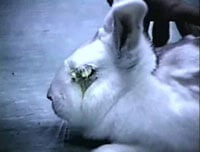
PETA, Rabbit in testing
Human Ear on Mouse

Animal Testing, Ghannan 2013
Hajar, Rachel. "Animal Testing and Medicine." U.S. National Library of Medicine. Medknow Publications, 2011. Web.<http://www.ncbi.nlm.nih.gov/pmc/articles/PMC3123518/>
Hajar, Rachel. "Animal Testing and Medicine." U.S. National Library of Medicine. Medknow Publications, 2011. Web. <http://www.ncbi.nlm.nih.gov/pmc/articles/PMC3709868/>
Margawati, Endang Tri. "Transgenic Animals: Their Benefits To Human Welfare." Actionbioscience. American Institute of Biological Sciences, 2003. Web <http://www.actionbioscience.org/biotechnology/margawati.html#primer>
Vesna, Victoria. "Biotechnology and Art." Youtube. 18 Sept. 2013. Web. <https://www.youtube.com/watch?v=PaThVnA1kyg&feature=youtu.be>
"Rabbits in Laboratories." People for the Ethical Treatment of Animals. Image. Web. 7 May 2015. <http://www.peta.org/wpcontent/uploads/2013/10/200_2D00_IssuesExperimentCrueltyRabbits.jpg>
Buy, Marie. "Transgenic Animal." NewinfoUK. 1 June 1997. Web. Image <http://www.newsnfo.co.uk/images/trans%20genics%20mouse%20ear%20googlei%20search.jpg>

No comments:
Post a Comment