Thursday, June 11, 2015

Event 3 Blog Assignment:

Last week, I made a visit to the Hammer Museum and got a chance to see "This Is The End" by  Ed Atkins, Loretta Fahrenholz, and Tommy Hartung. Watching the video was very confusing to me at first because I wasn't understanding the purpose of the inflatable thumb and what other purposes the thumb served in inserting the belly button, ear, and eye. After reading more information about the exhibition and re-watching the video, I see that the three artists have collaborated to create an art work addressing trauma, surrealism, melancholy, and uncanny. The part I was most interested in was understanding the purpose the thumb in Ed Atkins' illustrations. It seems that the thumb served as a way people in our society view our daily behaviors. Thumbs up present something is good and thumbs down represent something being bad. This is part of a consumer culture where we as a society are aware of these gestures because it is a socially learned behavior. I feel like the goal of this presentation was to show that people have different interpretations and make sense of daily life, objects, and people differently. In the case of the thumb, it seems that what others think do not matter and the thumb's behaviors (poking the eye, ear, belly button, etc)  are not influenced by others.


Super kind staff was nice enough to take a picture with me before I left for the day.
Overall, this exhibition was a bit difficult to understand. The video itself had amazing 3D features and is very engaging. However, I would not recommend this to others just because without reading about the work before hand, it is quite confusing and the ideas in the presentation is very board and can be open for interpretation. 

Event 2 Blog Assignment:

Earlier this quarter, I attended a lecture at the Board Art Center hosted by Louis-Philippe Demers. Unfortunately, there weren't any of his art work at the lecture so I was only able to see his past robotic art works via power pint presentation, It was interesting listening to Louis-Philippe Demer's experience as an artists and his inspiration for the robots he produces. Listening to his lecture also interested me in wanting to learn more about how the body works in real life and using that knowledge to bring robotics to life. I think that is really what inspired his work, through understanding the human body and using robots as a reflection of how the human body behaves. What I found most interesting was his dancing robots which he called the "tiller girls". He also mentioned that the perception of machine behaviors differ from people to people, People interpret and analyse behaviors differently, just like how people view art differently as it is very abstract and always open for interpretation. I agree with Louis when he said that with existing knowledge, people are able to build a connection between robots i biological motion and humans in reality. 
Tiller Girls by Louis-Philippe Demers
:Lecture on April 21, 2015 
Because Louis-Philippe Demer's lecture was a power point presentation, I wasn't able to take many pictures. I was able to include a picture of myself at the event right before the Demer lecture. 
Overall, the lecture was very interesting and I enjoyed listening to Louis's experiences with his past robotic works. Another perk of attending the event was getting free nacho cheese dip right before the lecture! 


Friday, June 5, 2015

Event 1 Blog Assignment:

For this event assignment, I visited the Making Strange: Gagawaka + Postmortem By Vivian Sundaram at the Fowler Museum at UCLA.

 At the exhibition I learned that the Gagawaka and Postmortem's collection of haunting sculptural objects on the mannequins and dummies was designed to target the social understanding of the human body and public concerns over human aging and illness. The collection used trash as a starting point for the garments on the mannequins. Different lines of garments were made out of foam cups,  surgical masks, medication pills, x-ray films and much more. There are also different mannequins with different medical objects inside of them.
Different parts of the human body are placed in the mannequins providing a different view of how the human body is currently viewed as. During week 4, we talked about the study of anatomy and how the art of the human body came about in the 1960s. The human body is central in understand how our identities in our society which includes gender, sexuality, and race. In this exhibition, I can see that the artist is challenging the currently social understanding of the human body by incorporating different parts of medical objects in the mannequins and dressing them in x-ray films, surgical masks, and creating a jumpsuit out of medication pills.
Garment made from red undergarment:
I found the red bra bandage garment interesting because looking from afar, it looks no different from a dress made of red ruffles. 
Garment made from surgical masks

Jumpsuit made of medication pills

Overall, I would recommend this exhibition for those who are interested in not only fashion but also the creative side of understanding the human body. Not to mention, many wacky displays of mannequins' bodies twisted in ways that are impossible in reality. 


Sunday, May 31, 2015

Week 9 - Space + Art:

This week, Professor Vesna introduced the idea of space and art and explained in her lecture video that "we have all been fascinated by the sky, the stars, and the planets" since the beginning of time. The unknown galaxy has continued to bring excitement to artists' lives and inspire them to create artistic pieces all around the world. One artist in particular, is recognizable for being highly specialized in the field of technological space art, Vincent Di Fate (Biography, 2004). Vincent is famous for his paintings of distant environments such as space and etc. His paintings of space are currently displayed in the Kennedy Space Center at Cape Canaveral.

The influence of space and art also inspired many artist to grow great interest in rockets and the stars before the 1960's. It was also during the time of the cold war that the influence of space and art were demonstrated in the space propaganda where both the USSR and the United States were in a race to space. Both USSR and the United States produced art pieces to show that their country was in the lead for developing advance space technology (Fenlon, 2012). 

If we look back in history, space films and science fiction novels on space have always been fictional. Before 1969, living and working in space seemed impossible and people can only imagine how the unknown galaxy looks like in space (NASA, 2014). Today, living and working in space is possible all thanks to artists, scientists, and engineers studying space technology. Artists continues to be inspired by the concept of space which brings us closer to understanding the solar system on a deeper level. 
The space station from 2001

Vesna, Victoria. "8 Space Intro 1280x720." YouTube. YouTube, 29 July 2013. Web. 23 May 2015. <https://www.youtube.com/watch?v=2dPAmpBiVHY>.

"Vincentdifate.com." Vincentdifate.com. Vincent DiFate, 2004. Web. 23 May 2015. <http://www.vincentdifate.com/biography.html>.

 "1968 Science Fiction Is Today's Reality." NASA. NASA Gov, 21 Oct. 2014. Web. <https://www.nasa.gov/mission_pages/station/main/2001_anniversary.html#.VWv0089Viko>  

 Nastasi, Allison. "Cosmic Art Installations Inspired by Space." Flavorwire. 5 Apr. 2014. Web.  <http://flavorwire.com/449482/cosmic-art-installations-inspired-by-space>
 
Fenlon, Wesley. "How Sci-Fi Propaganda Art Influenced The US and Soviet Space Race." Tested. 3 Apr. 2012. Web.<  http://www.tested.com/art/43726-sci_fi-art-propaganda-across-cultures/>

Images:

"1968 Science Fiction Is Today's Reality." NASA. NASA Gov, 21 Oct. 2014. Web. Image. <https://www.nasa.gov/sites/default/files/images/2001_station.jpg>

Fenlon, Wesley. "How Sci-Fi Propaganda Art Influenced The US and Soviet Space Race." Tested. 3 Apr. 2012. Web. Image. http://files.tested.com/photos/2012/04/02/55-37211-teaser1.jpg>

Fenlon, Wesley. "How Sci-Fi Propaganda Art Influenced The US and Soviet Space Race." Tested. 3 Apr. 2012. Web. Image. <http://files.tested.com/photos/2012/04/02/55-37213-bonestell-1.jpg>

Sunday, May 24, 2015

Week 8: Nanotech+Art

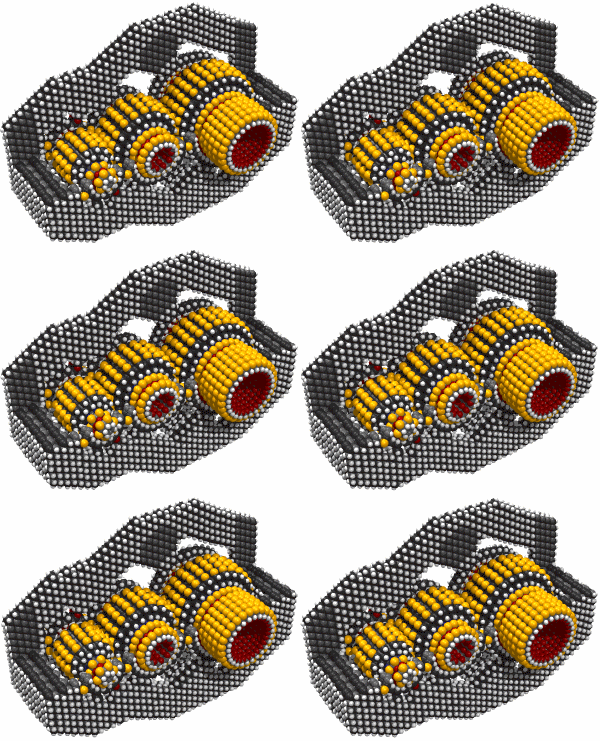
This week, Dr. Gimzewski talked about the origin of nanotechnology and how the development of this technology has the potential to change the world and is beneficial to the human race. Nanotechnology has the ability to build inventions at a molecular scale to make high performance products that can better peoples' lives (CRN, n.d). At the nanoscale, objects are so tiny that the naked eye cannot see them. According to Dr. Stoermer from the Institute of Materials Research, it is difficult for people to understand nanotechnology without a good background in multiple sciences related to the field. What we do know is that many scientists are currently studying and experimenting different substances at the nanoscale to find how their properties may be beneficial to the world. For example, engineers are currently trying to develop nano-size wires to make more powerful micro-processors and doctors are studying ways nanoparticles may be applicable to improve their patient's health (Bonsor and Strickland, n.d.).
Parallel shaft speed reducer- largest nano mechanical devices ever modeled

Nanotechnology is becoming a great part of our lives. Boyle reports 7 ways in which nanotechnology is changing the world we live in. One of them is the invention of the new gold nanoparticle sensors that has the ability to detect early stages of cancer. The use of nanoparticles is not only beneficial to cancer patients but can also help doctors find ways to treat all other patients and determine infections as well (Boyle, 2012). 

For this week's blog, as I researched more about nantechnology products, I found that clay coating keeps the air in tennis balls. Clay nanoparticles keep air molecules from escaping and helps tennis balls last longer (Discover Mag, 2010). Nanotechnology is used in almost everything in our lives, they are just to small for us to notice. 


 Bonsor, Kevin, and Jonathan Strickland. "How Nanotechnology Works." How Stuff Works. Web. 24 May 2015.< http://science.howstuffworks.com/nanotechnology.htm>

 Boyle, Rebecca. "7 AMAZING WAYS NANOTECHNOLOGY IS CHANGING THE WORLD." Popular Science. 12 Nov. 2012. Web. < http://www.popsci.com/science/article/2012-11/7-amazing-ways-nanotechnology-changing-world?image=1>

 "What Is Nanotechnology?" Center for Responsible Nanotechnology. Web. 24 May 2015. <  http://www.crnano.org/whatis.htm>

 "Nanotechnology Pt 1." Youtube. 21 May 2012. Web.<https://www.youtube.com/watch?v=q7jM6-iqzzE&feature=youtu.be>
  
 "The 9 Best Nanotechnology-Powered Products." Discover Magazine. 29 June 2010. Web.  <http://discovermagazine.com/galleries/zen-photo/n/nanotech-products>

Boyle, Rebecca. "7 AMAZING WAYS NANOTECHNOLOGY IS CHANGING THE WORLD." Popular Science. 12 Nov. 2012. Web Image. < http://www.popsci.com/sites/popsci.com/files/styles/medium_1x_/public/import/2013/images/2012/11/Cancer%20detector_0.jpg?itok=P3i9Elfg>

 "What Is Nanotechnology?" Center for Responsible Nanotechnology. Web Image. 24 May 2015. < http://www.crnano.org/srg-iii-pov-animation2.gif>


 "The 9 Best Nanotechnology-Powered Products." Discover Magazine. 29 June 2010. Web Image. <http://discovermagazine.com/~/media/Images/Zen%20Photo/N/nanotech%20products/311.jpg?mw=738>


Sunday, May 17, 2015

Week 7 Neuroscience + Art

The human brain is very complex and in attempt to understand it, artists are responding differently to the field of neuroscience. The human brain enables us to process information and create thoughts in nano seconds (Vesna, 2012). There is still much to learn about the human brain. Although we have made progress, the information we know currently are still limited like understanding the reason why we use only a small percentage of our brain to think and process our thoughts. What do we do with the rest of our brain? We have yet to find the reason behind the way our minds are able to control our body to perform certain tasks. Professor Vesna touched on the idea of consciousness this week and what is interesting to me is how we communicate using our mind and how we are able to comprehend the information given to us. Consciousness allows us to associate events and objects with what we know and what we are aware of (The Brain Bank, 2013). Consciousness is like a information processing system that enables all animals and humans to be conscious and aware of our surroundings (Keim, 2013).
Consciousness - Shutterstock


Many scientists and artists have attempt to study the human brain to understand its unique functions but still do not have a full explanation for how it really works. Theories of the brain began with the belief that the human heart controlled the human mind to understanding the mind using the measurement of the skull. The invention of electricity has helped scientists and artists research where the brain begins (Vesna, 2012). To begin, many scientists and artists until today have been trying to understand consciousness. Research has shown that when electricity stimulated a part of the brain called the clasutrum, a person becomes instantly unconscious (Lewis, 2014). Still, such findings fail to explain why other parts of the brain do not control consciousness and whether or not consciousness is present in brain damaged patients. In another research conducted by University of Cambridge, researchers found that some patients in vegetable state who lack the ability to integrate information efficiently are showing signs of consciousness which supports the idea of having awareness (Akst, 2014). However much research is needed in the neuroscience field in understanding how brain damaged patients may be assisted through the understanding of consciousness.
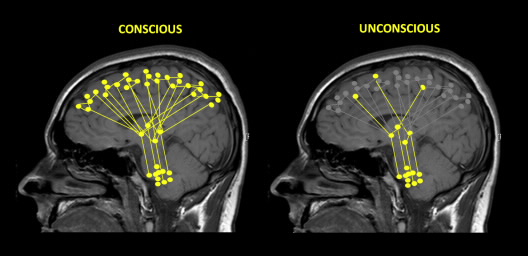

Conscious VS. Unconscious 
Illustrated brain networks in two vegetative patients (left and middle), but one of whom imagined playing tennis (middle), alongside a healthy adult (right). -Srivas Chennu


 "What Is Consciousness? A Scientist’s Perspective." The Brain Bank. 4 Mar. 2013. Web.  <http://thebrainbank.scienceblog.com/2013/03/04/what-is-consciousness-a-scientists-perspective/>

 Lewis, Tanya. "Scientists Closing in on Theory of Consciousness." Live Science. Purch, 30 July 2014. Web.<http://www.livescience.com/47096-theories-seek-to-explain-consciousness.html>.  

 Vesna, Victoria. "Neuroscience-pt1." Youtube. UCOnline, 17 May 2012. Web. <https://www.youtube.com/watch?v=TzXjNbKDkYI&feature=youtu.be> .  

 Keim, Brandon. "A Neuroscientist’s Radical Theory of How Networks Become Conscious." Wired. 13 Nov. 2013. Web. <  http://www.wired.com/2013/11/christof-koch-panpsychism-consciousness/>.

 Akst, Jef. "Still There." The Scientist. 20 Oct. 2014. Web.  <http://www.the-scientist.com/?articles.view/articleNo/41253/title/Still-There/>

 Lewis, Tanya. "Will We Ever Understand Consciousness? Scientists & Philosophers Debate." Live Science. Purch, 31 May 2013. Web. Image <http://i.livescience.com/images/i/000/053/366/i02/consciousness.jpg?1370032937> .

 "What Is Consciousness? A Scientist’s Perspective." The Brain Bank. 4 Mar. 2013. Web. Image  <http://thebrainbank.scienceblog.com/files/2013/03/ev.owa_2.jpeg>.

 Akst, Jef. "Still There." The Scientist. 20 Oct. 2014. Web. Image  <http://www.the-scientist.com/images/Nutshell/October2014/brain%20scans.jpg>


Sunday, May 10, 2015

Week 6

This week, Professor Vesna talks about biotech and art and the controversy on how animals are used for testing in bioart projects. When talking about bioarts and technology, it is worth mentioning Eduardo Kac, the creator of the GFP bunny, Alba. He used a gene called the glowing green fluorescent protein (GFP) found in the Aequorea Victoria jellyfish and modified it to make it more powerful and injected into rabbit egg cells which ultimately spread throughout the bunny's body creating a glowing body. Alba is known as a transgenic animal that carries a foreign gene from another animal that has been inserted by humans to have similar features of the other animal (Transgenic Animals, 2011). By using biotechnology, scientists are able to study genetics on a different level. Many scientist have been known to use animals to study biological processes and diseases. The GFP gene is able to tag certain genes of protein in the human body allowing scientists to watch the effective of drugs and illnesses without actual surgery. Some benefits that come from transgenic animal studies include developing disease resistance and other medical applications. Scientists are in the process of producing disease resistant animals such as influenza resistant pigs which is a study that will benefit many humans from dying of disease illnesses (Margawati, 2003).

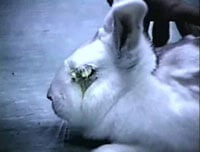
However there has been a strong controversy on whether it is right to test on animals. According to the People for the Ethical Treatment of Animals, more than 241,000 rabbits are abused in U.S. laboratories every year. Many animals have suffered greatly to support successful artists and scientists in genetic testing and development. Those in favor of animal testing however would argue that experiments on animals are necessary to advance medical and biological knowledge (Hajar, 2011). Even though there is a strong debate between those who study bioart and those who are anti animal testing, biotechnology and studies in genetics have no doubt provided humans with technological and medical advancement and will most likely continue to do so in the future. 
PETA, Rabbit in testing
Human Ear on Mouse
Animal Testing, Ghannan 2013

 "Rabbits in Laboratories." People for the Ethical Treatment of Animals. Web. 7 May 2015. <http://www.peta.org/issues/animals-used-for-experimentation/rabbits-laboratories/>

 Hajar, Rachel. "Animal Testing and Medicine." U.S. National Library of Medicine. Medknow Publications, 2011. Web.<http://www.ncbi.nlm.nih.gov/pmc/articles/PMC3123518/>

 Hajar, Rachel. "Animal Testing and Medicine." U.S. National Library of Medicine. Medknow Publications, 2011. Web. <http://www.ncbi.nlm.nih.gov/pmc/articles/PMC3709868/>

 Margawati, Endang Tri. "Transgenic Animals: Their Benefits To Human Welfare." Actionbioscience. American Institute of Biological Sciences, 2003. Web <http://www.actionbioscience.org/biotechnology/margawati.html#primer>  

 Vesna, Victoria. "Biotechnology and Art." Youtube. 18 Sept. 2013. Web. <https://www.youtube.com/watch?v=PaThVnA1kyg&feature=youtu.be>  

 "Rabbits in Laboratories." People for the Ethical Treatment of Animals. Image. Web. 7 May 2015. <http://www.peta.org/wpcontent/uploads/2013/10/200_2D00_IssuesExperimentCrueltyRabbits.jpg>  

 Buy, Marie. "Transgenic Animal." NewinfoUK. 1 June 1997. Web. Image <http://www.newsnfo.co.uk/images/trans%20genics%20mouse%20ear%20googlei%20search.jpg>  
 Ghannam, Talha. "Animal Testing – Right or Wrong." Centre for Islam Medicine. 23 Oct. 2013. Web. <http://www.thecim.org.uk/wp-content/uploads/2014/10/Animal-testing.jpg>  

Sunday, April 26, 2015

Medicine+Technology+Art

This week Dr.Vesna talked about how important art is relative to the development of medicine and technological advancement. Whether it is in the past or in the present, anatomy and dissection has been greatly looked at as a collaboration of art and science. Artists who focus their work on the human body are great assets to researchers because their art illustrations can help researchers gain a better understanding how the human body works and document important facts in the process (Dr. Vesna, 2012). The art of the human body is also central for understanding how our identities are shaped in our society which includes gender, sexuality, race, and ethnicity (MoMa, n.d.). During the 1960s and 1970s, most of the work produced by human body artists focused on depicting how western art perpetuated idealizations of the female form. These idealizations still affect us today in the way we think about how we look and how we should act in order to fit with social conventions. Art itself is a reflection of humanity (Ruggles, 2011).
Self portrait by John Coplans 


The Human Body in Art by Joanne Beaule Ruggles

We have been dissecting human bodies since the beginning of human history because dissection is an effective way of understanding the human body. The study of human anatomy has contributed to the development of modern medicine. Anatomical illustrations helped improve the medical community. Andreas Vesalius for example, is one of the most influential figures in the scientific world because of his passion for studying the human body.The anatomical images in his book De Humani Corpis Fabrica was the earliest presentation of human anatomy (Famous Scientists, n.d.). His work showed the complexity of the human body formation and influenced many other scholars and artist to take interest in the study of the human body which lead to further development in this field of study (British Library, n.d.). 
Muscle Man by Andreas Vesalius


1) "Investigating Identity." Moma. Web. <http://www.moma.org/learn/moma_learning/themes/investigating-identity/the-body-in-art>.

2) MoMa Learning. John Coplans. Self Portrait. Digital Image .

3) Vesna, Victoria. "Medicine Pt 1: Human Body and Medical Technologies." UCOnline, 21 Apr. 2012. Web. 26 Apr. 2015. <https://youtu.be/Ep0M2bOM9Tk>.

4) Ruggles, Joanne Beaule. "Joanne Beaule Ruggles Captures the Human Body in Art."Figurative Artist. 25 Feb. 2011. Web. 26 Apr. 2015. <http://www.figurativeartist.org/joanne-beaule-ruggles-captures-the-human-body-in-art/>.
5) Figurative Artist. Joann Beaule Ruggles. The Human Body in Art. Digital Image.

6) "Vesalius's Renaissance Anatomy Lessons." Learning Bodies of Knowledge. British Library. Web. 26 Apr. 2015. <http://www.bl.uk/learning/artimages/bodies/vesalius/renaissance.html>.

7) Library British. Andreas Vesalius. Muscle Man. Digital Image.

8) "Andreas Vesalius: Contributions and Achievements:." Famous Scientists: The Art If Genius. Web. 26 Apr. 2015. <http://www.famousscientists.org/andreas-vesalius/>.


Sunday, April 19, 2015

Robotics + Art

This week, Dr. Vesna discusses how Gutenberg's invention of the printing press was proven to make mass production possible which also inspired other scientists to develop ideas about art and robotics. However, creations of robotics using art have not always been beneficial to our society. Take Ford for example. Ford was the first to use the idea of mass production and create the assembly line (Uconline Program, 2012). His used his idea of the assembly line to create cars and had different labors working on different parts (U-S-History, n.d.).

 Back in the early 1940s, it was hard to own a car and only the wealthy were able to afford for such a luxury item. The assembly line lead to the problem of taylorism where workers began to look like they were apart of the products they were producing (Bedoire, n.d.). In a way, Ford's use of the assembly line is an example of Marxism where Marx specifically studied the class relations and societal conflicts between the two class: capitalist and proletariat (Nisbet, 2013). The cars Ford were producing were made so that only the capitalists would be able to afford them. Marx understood that idea and also focused on studying how as a result of capitalism and laborers being stripped away from their mode of production, laborers become alienated and dehumanized (Ollman, 2015). Frederick Winslow Taylor's idea of taylorism is very similar to Marx's idea of alienation because in both perspectives, laborers are not aware that they are being objectified.
Sweden, 1940s, Telefonplan Plant


"Henry Ford." United States History. Web. <http://www.u-s-history.com/pages/h1621.html>.

United States History. Early Ford Assembly Line. Digital Image.

Ollman, Bertell. "What Is Marxism? A Bird's-Eye View." Dialectical Marxism. Bertell Ollman. Web. <http://www.nyu.edu/projects/ollman/docs/what_is_marxism.php>.

Robert A., Nisbet. "Social Science." Encyclopaedia Britannica. 2013. Print.<http://www.britannica.com/EBchecked/topic/551385/social-science/38930/Marxist-influences>

Chaweye, Soraya. Fordism Calling. Digital Image.

Bedorie, Fredric. Sweden 1940s, Telefonplan Plant. Digital Image.

Bedoire, Fredric. "MIDSOMMARKRANSEN! TAYLORISM AS ARCHITECTURE." The History of Ericsson. Web. <http://www.ericssonhistory.com/places/stockholm/Midsommarkransen--Taylorism-as-architecture/>.

Vensa, Victoria. Robotics + Art LectureUCOnline. N.p., n.d. Web. 19 Apr. 2015. <https://www.youtube.com/watch?v=oAZ8bo9T_Pk>, <https://www.youtube.com/watch?v=wkP7oSZVkbg>.

Sunday, April 12, 2015

Week 2

Composition in Brown and Grey by Piet Mondrian 1913

Even thought math and art may seem very different and people often times do not see how they interrelate, people who like math will most likely look for mathematics in art. Math is needed everywhere and in almost all art work as it is needed for basic measuring of lines and different angles. This week, Dr. Vesna talked about math and art and how artist use mathematics to create art work. In her lecture, one of the artists who use mathematics to create art is Mondrian, a dutch artist in the 1930s who was famous for using horizontal lines in many of his drawings and paintings. Due to his strong believes in mathematics, he used lines and shapes to outline his creations and use primary colors to express reality and nature.  Mondrian believed that paintings using lines and colors should serve as an example to other arts in defining “beauty”. 

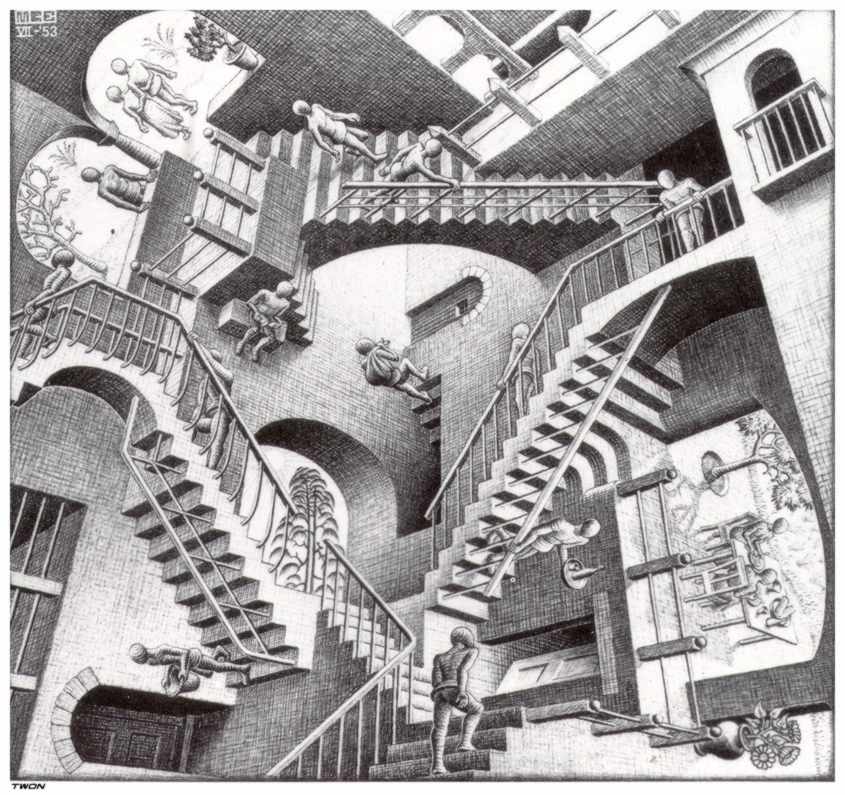
I find M.C Escher's work especially fascinating because he is so talented in creating art pieces that are unique and different from other artists. M.C. Escher was famous for creating art work that is mathematically impossible but to the human eye look very realistic just like this piece below. In this drawing, the staircases are ascending and descending which looks very much real but mathematically impossible. 
Relativity by M.C. Escher
Circle Limit III by M.C. Escher

M.C Escher also believed that with simple shapes such as squares, triangles, and hexagons are sufficient enough to create art which inspired him some of his art pieces in Alhambra Sketch.

Sources and Links:

1) https://youtu.be/mMmq5B1LKDg
2)http://mathcentral.uregina.ca/beyond/articles/Art/art1.html
3)http://www.moma.org/collection/browse_results.php?criteria=O%3AAD%3AE%3A4057&page_number=4&template_id=1&sort_order=1
4) http://www.nga.gov/collection/gallery/ggescher/ggescher-main1.html
5)http://www.theartstory.org/artist-mondrian-piet.htm

Works Cited:

Vesna, Victoria. “Mathematics-pt1-ZeroPerspectiveGoldenMean.mov.” Cole UC online. Youtube, 9 April 2012. Web. 11 Oct. 2012. <http://www.youtube.com/watch?v=mMmq5B1LKDg&feature=player_embedded>
Escher, M.C. Relativity. 1953. Photograph. Math CentralWeb.<http://mathcentral.uregina.ca/beyond/articles/Art/relativity.jpg>

Escher, M.C. Circle Limit III. 1959. Photograph. M.C. Escher Web. <http://mcescher.com/wp-content/uploads/2013/10/LW434-MC-Escher-Circle-Limit-III-1959.jpg>

Mondrian, Piet. Composition in Brown and Grey. 1913. Photograph. The Museum of Modern Art: The Collection. Web <http://www.moma.org/collection_images/resized/155/w500h420/CRI_151155.jpg>


J. Bendien. Nieuwe richtingen in de schilderkunst: Het neo-plasticisme [New directions in painting: Neo-Plasticism] (Amsterdam, 1935), pp. 21–45. Oxford University Press. 


Sunday, April 5, 2015

Week 1 Blog:

In Toward a Third Culture: Being in Between, Professor Vesna talks about how there is divide between the literary humanities and sciences creating the "two cultures". Professor Vesna remind readers of C.P. Snow's argument that the curricula of schools and universities are the reasons for the separation between the humanities and sciences. Both Professor Vesna and Snow argue that it is impossible to keep the arts separate from the sciences because work from both professions are interrelated. According to Professor Vesna, technologies and scientific discoveries are what inspires artists to create and explore new innovations. However, schools and universities reinforce this inequality by dividing the literary humanities and sciences into two cultures. An example of the two cultures is demonstrated on UCLA campus with the sciences in South campus and the art humanities in North campus. Before reviewing this week's readings, I never thought about the importance of science in relation to art. I never took the time to think about how art using computer technologies is a form of art. Understanding Snow's perspective changed my thinking about students from North and South campus. South campus majors have knowledge about sciences that can be beneficial to North campus majors studying arts and vice versa. I believe that understanding the importance of science in relation to the humanities is essential in everyday life, not just in creating art. People depend on one another for information and knowledge. Understanding information beyond our field of study can make us more knowledgeable and have a better understanding of the world.

                                            Dynamic Performance of Nature by EB Office:
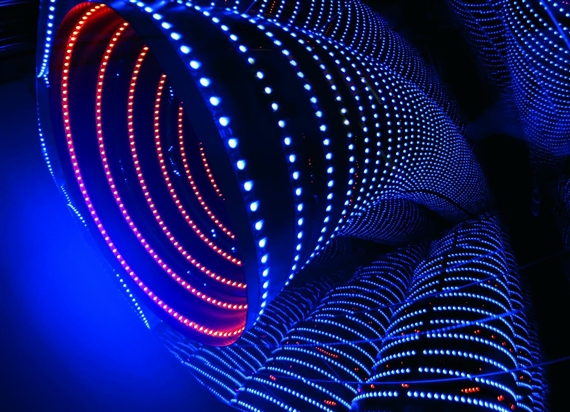
Art Fair of the Future: Tunnel View
How Art, Science, and Technology Interact in Southern California


Snow, C.P. The Two Cultures and The Scientific Revolution. Cambridge University Press. New York. 1961.
Vesna, Victoria. Toward a Third Culture: Being in Between in Leonardo, Vol. 34, No. 2.The MIT Press. 2001
"Dynamic Peformance of Nature by EB Office". Archinect. Connecting Architects Since 1997. Walter, Alexander. 21 Nov. 2011. 
"Art Fair of the Future: Tunnel View". Mutual Art. Kotter, Han. 1 Feb. 2012.
"How Art, Science, and Technology Interact in Southern California" KCET. Nowlin, Stephen. 20 March. 2015.


Thursday, April 2, 2015

Hello All,

My name is Tsz Wong but I prefer to be called Lulu. I am currently a 4th year student majoring in Sociology with a minor in Education. I enjoy little adventures and playing sports. For spring break, my boyfriend and I went para-sailing in Newport Beach! The weather was nice and we had a great time! I signed up for this course because I thought it would be interesting to learn more about how scientific innovations inspire the art culture.


Here is a picture of us 800 ft up in the air (it was actually pretty scary).